
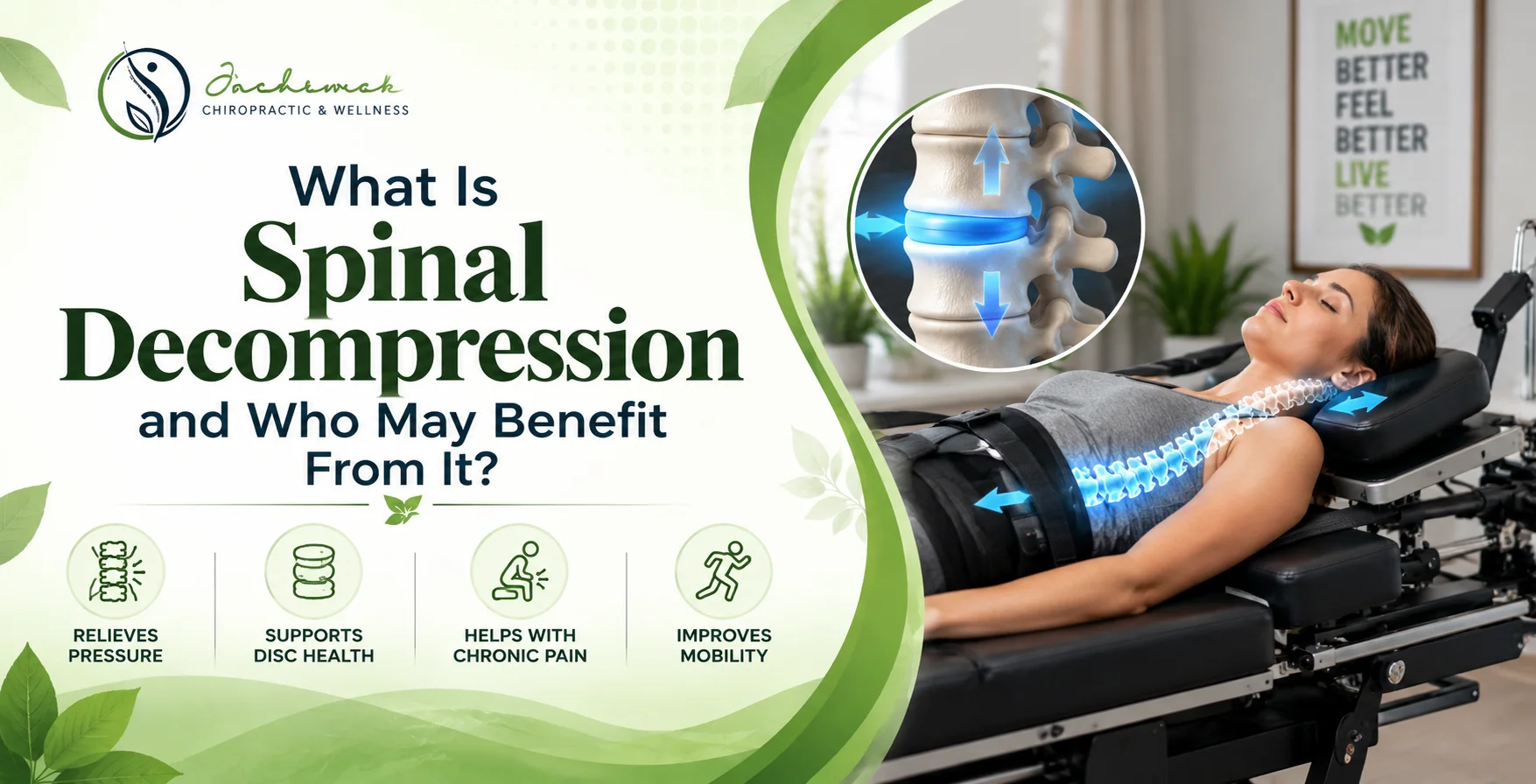
Understand how non-surgical spinal decompression therapy relieves pressure on the spine and helps manage chronic pain and disc issues.
What Is Spinal Decompression and Who May Benefit From It
Spinal decompression is a gentle non-surgical treatment for back pain. You lie on a special table while it gently stretches your back. The process takes some pressure off the areas that are causing discomfort. It can be helpful for people dealing with a herniated disc, sciatica, or back pain that keeps coming back.
Key Takeaways
- •Spinal decompression is a non-surgical stretching treatment to ease back and nerve pain.
- •It mainly helps people with a herniated disc, sciatica, degenerative disc disease, or ongoing lower back pain.
- •Research on results is mixed overall, but many patients do see real pain relief, especially when paired with rehab exercises.
- •A typical treatment plan runs several weeks, with sessions on a special table followed by simple exercises
- •In Florida, treatment should always come from a licensed chiropractic physician regulated by the state
01What Spinal Decompression Actually Does to Your Spine
Spinal decompression is a controlled, motorized traction technique. A table pulls specific segments apart and eases pressure inside the disc space, so a bulging or herniated disc has room to retract. When a lumbar disc herniates, pressure inside it is often positive. The table creates a temporary negative pressure zone. That drop can pull fluid and nutrients back into the disc and shrink the herniation itself.
A retrospective cohort study published through the National Center for Biotechnology Information tracked lumbar disc height with CT imaging before and after a 6 week protocol on the DRX9000 system, and found that increases in disc height correlated with drops in discogenic low back pain. That's not marketing language. That's a measured structural change tied to a measured symptom change.
This is also fundamentally different from spine surgery. A laminectomy or discectomy involves cutting into tissue to remove bone or disc material. The non-surgical version never breaks skin.
80%
of adults report low back pain at some point, per NIH data
6
week course is the typical clinical decompression protocol length
94
patient chart review found meaningful chronic low back pain relief
These figures come from federal health data and published clinical chart reviews, cited below.
02Who Actually Benefits From Spinal Decompression?
For candidacy, the clearest responders tend to fall into a few categories.
- •Lumbar or cervical disc herniation with radiating nerve pain, confirmed through a physical exam and imaging.
- •Chronic sciatica that hasn't resolved with rest, medication, or a short course of physical therapy.
- •Degenerative disc disease, where discs have thinned and lost hydration over years, common past 40.
- •Facet syndrome, where the small joints along the spine are irritated rather than the disc itself.
- •Post car accident spinal compression, a frequent finding in Tampa patients dealing with whiplash.
Age alone rarely disqualifies someone. The more relevant factors are vertebral integrity and the absence of severe osteoporosis, which lines up with how most Tampa clinics actually screen patients rather than turning people away based on a birth year. There's a narrower group too, people whose sleep is wrecked by nighttime pain flare ups. If that's you, it's worth reading how chiropractic care can improve sleep quality and reduce nighttime pain, since this is often one piece of that fix, not the whole plan.
BEFORE DECOMPRESSION
- •Sharp pain radiating down one leg past the knee
- •Numbness or tingling in the foot or toes
- •Difficulty sitting through a full work day
- •Disrupted sleep from nighttime nerve pain
- •Reliance on daily anti inflammatories
AFTER A FULL PROTOCOL
- •Reduced or resolved radicular leg pain in a majority of responders
- •Improved sensation as nerve compression eases
- •Longer pain free sitting and standing tolerance
- •Fewer nighttime wake ups tied to spinal pressure
- •Lower dependence on medication for daily function
These are typical outcome patterns drawn from clinical case series, not a promise for any individual patient.
03Does the Research Actually Support Spinal Decompression?
The research is genuinely mixed, not uniformly glowing, and you deserve to know that before committing six weeks to a protocol.
A narrative review published through PubMed on non-surgical approaches to lumbar disc herniation found that traction-based therapies. Those are real findings and we're not going to bury it.
- •A randomized study out of Seoul National University Bundang Hospital, indexed through PMC, compared the real treatment against a sham version and tracked both pain scores and MRI-measured herniation volume, not just self-reported comfort.
- •A separate retrospective chart review of 94 chronic low back pain patients, published in Pain Practice and indexed on PubMed, reported meaningful pain reductions. And a case report through PMC documented a patient with a double level disc herniation who had already failed physical therapy, avoided surgery entirely, and showed measurable structural improvement on repeat imaging.
“Non-surgical spinal decompression has become a first line option we consider before recommending invasive intervention, particularly for patients with contained disc herniations who have not responded to standard conservative care.”
American Chiropractic Association, clinical practice guidance summary
So, This isn't a guaranteed fix, and any provider who tells you it is hasn't read the same literature we just did. It's a reasonable, low risk option to try before surgery, particularly paired with a broader rehab plan rather than sold as a standalone miracle.
Reported Chronic Low Back Pain Reduction Across Published Decompression Studies
“Patients come in expecting decompression to be a miracle machine, and I have to reset that expectation honestly. What it actually does is create the mechanical conditions for a disc to heal itself, and that only works if we pair it with the right rehab and give the tissue enough time.”
Dr. Glen Gunderson, DC, Jachimek Chiropractic & Wellness, Tampa, FL
Patients who add the rehabilitation exercises outlined in our piece on the benefits of regular chiropractic care consistently report better, longer lasting outcomes.
04What a Spinal Decompression Session at Jachimek Chiropractic Looks Like
Walk in expecting a table. You lie down fully clothed, face up or face down depending on the segment involved, and a harness secures your pelvis and torso. The system applies a computer controlled pulling force in cycles, alternating stretch and release, over roughly 20 to 30 minutes.
A full course isn't one visit. Most protocols run 15 to 30 sessions across four to six weeks, several times weekly early on, tapering as symptoms improve. Consistency drives the outcome more than any single visit does.
Initial Exam
A doctor confirms candidacy and rules out contraindications before scheduling the first session.
Weeks 1 to 2, Active Phase
Sessions typically run three to five times weekly while pain is at its highest.
Weeks 3 to 4, Rehab Integration
Core and postural exercises get layered in as pain decreases.
Weeks 5 to 6, Tapering
Frequency drops and the doctor reassesses function and whether maintenance visits are needed.
Who Should Not Use Spinal Decompression
Decompression therapy is not appropriate for pregnant patients, individuals with spinal fractures, severe osteoporosis, spinal tumors, abdominal aortic aneurysm, or metal implants and hardware from prior spinal surgery. A qualified chiropractic physician should always screen for these conditions before starting treatment.
05Spinal Decompression vs. Other Common Back Pain Treatments
Every option here has a place. The honest question isn't which is best in the abstract, it's which fits your diagnosis and risk tolerance.
| Treatment | Invasiveness | Typical Timeline | Best Fit For |
|---|---|---|---|
| Spinal Decompression | Non-invasive | 4 to 6 weeks | Disc herniation, sciatica, degenerative disc disease |
| Standard Chiropractic Adjustment | Non-invasive | Ongoing, session by session | Joint restriction, general spinal misalignment |
| Physical Therapy Alone | Non-invasive | 6 to 12 weeks | Muscular imbalance, post injury strengthening |
| Epidural Steroid Injection | Minimally invasive | Days for relief, temporary | Acute inflammation flare ups |
| Discectomy Surgery | Invasive | Weeks of recovery | Severe, progressive, or emergent nerve compression |
For nerve pain radiating down the leg, our guide on the difference between sciatica and lower back pain walks through how a doctor tells the two apart during an exam.
06Is Spinal Decompression Regulated, and Why Does That Matter in Tampa?
Yes. The chiropractic doctors that practice in Florida, and specifically Tampa Bay area, are licensed and regulated by Chapter 460 of the Florida Statutes through the Florida Board of Chiropractic Medicine. This board exists solely to ensure the person running that table knows what they are doing.
It is worth checking whether your provider is licensed by Florida before making appointments in Carrollwood, Westchase, Citrus Park, or anywhere in Tampa.
At Jachimek Chiropractic & Wellness, treatment programs are developed and supervised by licensed physicians, Dr. Juliet Marvenko (board-certified in three states), and Dr. Donny Morris (Palmer College of Chiropractic graduate).
Ready to Find Out If Decompression Can Help Your Spine?
Call 813.960.2225 or book online for a $47 new patient exam at our 5111 Ehrlich Road Ste 128, Tampa, FL 33624 location.
Frequently Asked Questions
Is spinal decompression painful?
Patients describe it differently. They say it's a deep and mild stretch rather than pain. Physicians will adjust your sessions to your comfort level and stop immediately if sharp pain occurs.
Does insurance cover spinal decompression therapy in Florida?
Coverage depends on diagnosis and plan. Jachimek Chiropractic works with most major insurance companies and they can verify your specific benefits before treatment starts.
What is the difference between traction and spinal decompression?
Traction applies a constant pulling force, while true decompression uses a computer controlled, cyclical pull and release pattern designed to reduce intradiscal pressure more precisely.