
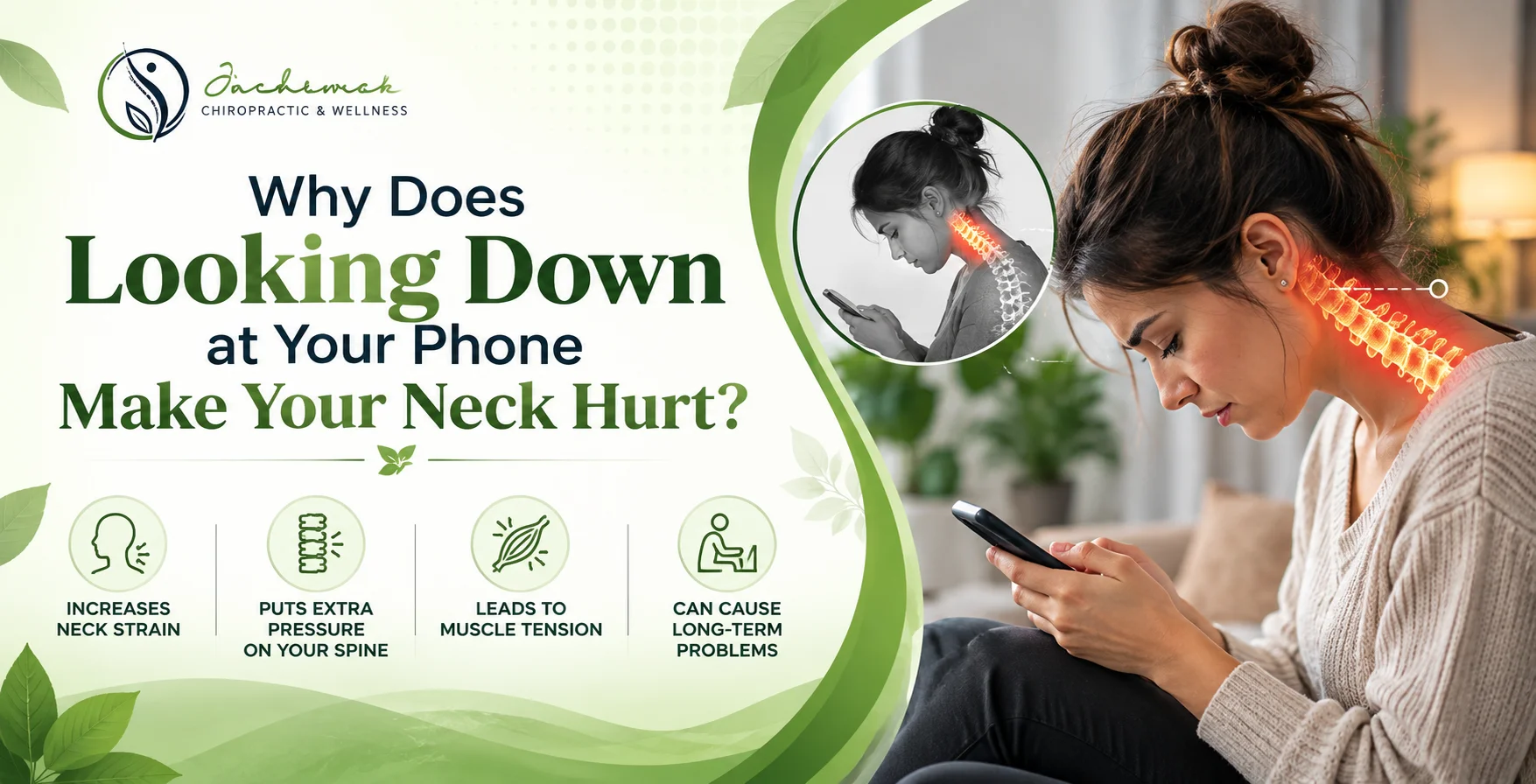
Understand how "text neck" and poor posture while using your smartphone can cause neck pain, muscle tension, and long-term spinal issues.
JACHIMEK CHIROPRACTIC
Why Does Looking Down at Your Phone Make Your Neck Hurt?
Jachimek Chiropractic & Wellness | Tampa, FL
It's more of a mechanical issue; nothing mysterious behind it. Looking down at a device, such as a screen or keyboard, with the head extended forward, requires a large amount of effort from the neck muscles. Once it reaches a certain degree of tilting, it feels as if you're carrying a bowling ball on your neck. After hours of this daily, the muscles, discs and joints of your vertebrae will start to complain about the overload.
KEY POINTS
- Forward head posture adds measurable pounds of leverage force to the cervical spine for every inch the head drifts forward of the shoulders.
- Tampa Bay's commute and desk culture stack extra flexion time onto an already phone heavy day.
- The pain pattern normally begins in the trapezius and at the base of the skull before it ever reaches the lower neck.
- Posture correction plus targeted chiropractic care is better than stretching for lasting relief.
- Ignoring the pain pattern, for a time can speed up disc wear that would otherwise appear only many decades later.
01The Math Nobody Warned You About
Start with the head. It weighs roughly ten to twelve pounds sitting neutral on top of the spine, which the neck muscles handle without complaint all day long. The trouble starts the instant that head tips forward, because the spine is not built to carry weight on a lever arm. Research published through PMC on craniovertebral posture puts a number on it directly, roughly ten additional pounds of load for every single inch the head drifts forward of the shoulders.
The Washington Post covered the biomechanics behind this in detail, and newer imaging work keeps confirming the same curve.
02This Is Worse Than It Sounds
According to a 2025 imaging study published in the Journal of Spine Surgery, smartphone texting can actually change alignment in healthy young adults. The biggest shifts happen in the part of the neck, not the lower part that textbooks usually blame.
27 lbs
Effective force on the cervical spine at just a 15 degree forward tilt
49 lbs
Force at a 45 degree tilt, the angle most people hit while reading a text message below chest height
5h 16m
Average daily phone time for American adults in 2026
29.26 min
Average one way commute across Tampa Bay in 2026
03Why Tampa Bay Makes This Worse, Not Better
Every metro area has phones. Not every metro area has Tampa's particular combination of long car time and desk jobs stacked end to end. The average one way commute across the Tampa Bay region sits at 29.26 minutes in the 2026 Regional Competitiveness Report, and drivers stuck at red lights on Dale Mabry or Ehrlich Road are not exactly staring straight ahead the whole time. Add in the fact that commuters citywide average 24.8 minutes behind the wheel on top of a full workday, and the forward flexed neck starts before the workday even begins.
“Patients tell me their neck pain started this year. It did not start this year. It started the year they got a smartphone and never adjusted how they hold their head. The body just took its time sending the invoice.”
— Dr. Glen Gunderson, “Dr. G” | Doctor of Chiropractic, Jachimek Chiropractic & Wellness Center, Tampa
Then the workday itself adds more. American adults are now spending an average of 5 hours and 16 minutes on their phones every day as of 2026. That's a 14% increase, from 2 years ago. If you add a Tampa commute, a desk job and evening phone scrolling together the neck never gets enough time to rest and recover. This is not a phone problem exclusively. It is a Tampa Bay lifestyle problem wearing a phone shaped disguise.
04What Actually Happens Inside the Neck?
Forward head posture does not just tire out muscles. It changes the mechanics of the joints underneath them. Spine-health.com's clinical overview explains that the lower cervical vertebrae, particularly C5 and C6, already carry the most load from the head's resting weight, so any added forward tilt concentrates even more compressive force right there. Over years, that steady overload is associated with faster disc degeneration and facet joint wear, changes that would normally show up decades later on someone's x-ray.
A separate finding worth taking seriously, from a controlled study on cervical spinal stiffness, showed that a 45 degree flexed head position measurably reduces the spine's structural stiffness at the upper neck. Less stiffness under load means less control, and less control is how minor strain becomes a recurring injury. The muscles get sloppy because the joints are giving them a bad platform to work from.
Cervical Spine Effective Load by Head Tilt Angle
Normal. No strain.
Fine for a minute, not for an hour.
Upper trap tightness begins.
Base of skull ache, stiff turns.
Sharp pinch, possible tingling to the arm.
Biomechanical load calculation based on published craniovertebral clinical models.
| Head Tilt Angle | Effective Load on Neck | What It Feels Like |
|---|---|---|
| 0 degrees, neutral | 10 to 12 lbs | Normal. No strain. |
| 15 degrees, glancing down | 27 lbs | Fine for a minute, not for an hour. |
| 30 degrees, scrolling | 40 lbs | Upper trap tightness begins. |
| 45 degrees, texting low | 49 lbs | Base of skull ache, stiff turns. |
| 60 degrees, chin to chest | 60 lbs | Sharp pinch, possible tingling to the arm. |
05The Muscle Groups Doing All the Complaining
- The upper trapezius muscle (connects the neck and the shoulder) becomes tight first. You may consider this the first sign of stress.
- The suboccipital muscles located at the bottom of the skull work hard trying to keep the eyes level when the neck moves forward.
- The deep cervical flexors the muscles that are supposed to support the neck become weak because they're not used enough and no longer do their job.
- Pectoral muscles shorten as the shoulders round forward, which pulls the whole upper body further out of alignment.
06Just Stretching Neck Won’t Fix It Unfortunately
Stretching alone rarely solves this, and anyone selling a 5 minute daily stretch as a full fix is skipping the joint mechanics part of the lecture. Physiopedias clinical summary on posture says that the length‑tension relationship of the neck muscles changes after months or years of forward flexion. Passive stretching can relieve the symptom. However, it doesn’t fix the postural habit or the joint restriction that causes the problem. That’s why a layered approach is valuable.
A Layered Approach to Lasting Posture Correction
07Chiropractic Care May Stop Text Neck Pain Faster Than Anything Else
A typical plan through the chiropractic services at Jachimek Chiropractic & Wellness Center starts with a hands on assessment of cervical range of motion and joint restriction. Spinal decompression therapy takes pressure off compressed discs directly, adjustments restore motion to joints that have been locked in a forward flexed pattern, and targeted rehabilitation exercises retrain the deep neck flexors that stopped doing their job months ago.
Dr. Donny Morris, DC, who trained at Palmer College of Chiropractic in Daytona Beach and dealt with his own chronic back pain from years in construction, builds these plans around getting patients back to full function rather than just quieting the pain for a week.
“People rarely feel tech neck while they are actually looking down. The pain shows up later as a cumulative bill, because a person engrossed in a screen almost never notices the strain building in real time.”
— Dr. Andrew Bang, DC | Chiropractor, Cleveland Clinic
084 Simple Posture Fixes You Can Start Today
- If you are reading a story or doing a ton of paperwork set a timer for 20 minutes and do 10 slow chin tucks when the timer goes off.
- Always try to make sure your phone is at the level of your eyes even if it sometimes feels a little weird.
- Change the car headrest and mirror so that leaning forward at lights on I-275 doesn't feel normal anymore.
- Replace one night of scrolling with a minute of scapular retraction exercises against a wall.
None of this means you have to quit using smartphones and that was never an idea in the first place. It requires treating the neck like the load‑bearing structure that it actually is. Readers who want a library of posture and pain topics can browse The Wellness Journal for more on the connection between daily habits and chronic pain.
Your Neck Has Been Sending Signals. Time to Listen.
Discover targeted neck strain relief and restore proper cervical spine alignment at Jachimek Chiropractic & Wellness in Tampa.
Frequently Asked Questions
Does it take a long time to fix head posture?
Well, most people feel less pain after a couple of weeks, maybe 4, if they're consistent with treatment. But getting your posture back to normal and building up those deep neck muscles takes closer to 2-3 months.
Is text neck the same as a pinched nerve?
Not exactly. Text neck describes the postural pattern and muscle strain, while a pinched nerve involves actual nerve compression, often from a disc or joint change that developed after prolonged poor posture.
Do kids and teens get text neck too?
Yes, and often earlier than adults expect. Teens who spend hours on phones and laptops for schoolwork show the same forward flexed posture patterns, sometimes with faster onset of symptoms since their postural habits are still forming.
Will a standing desk fix neck pain from screen use?
A standing desk changes hip and lower back load more than neck angle. Screen height relative to eye level matters far more for the neck than whether someone is sitting or standing.
Disclaimer: This article is for informational and educational purposes only. It shouldn’t be a substitute for medical advice. Always consult with a qualified healthcare practitioner before making any medical treatment decisions.
Tired of Dealing with Smartphone Neck Stiffness?
Jachimek Chiropractic & Wellness helps Tampa Bay patients relieve text neck and spinal compression at the root cause. New patients start with a comprehensive exam and customized treatment plan for $47.
Claim the $47 New Patient Special →