
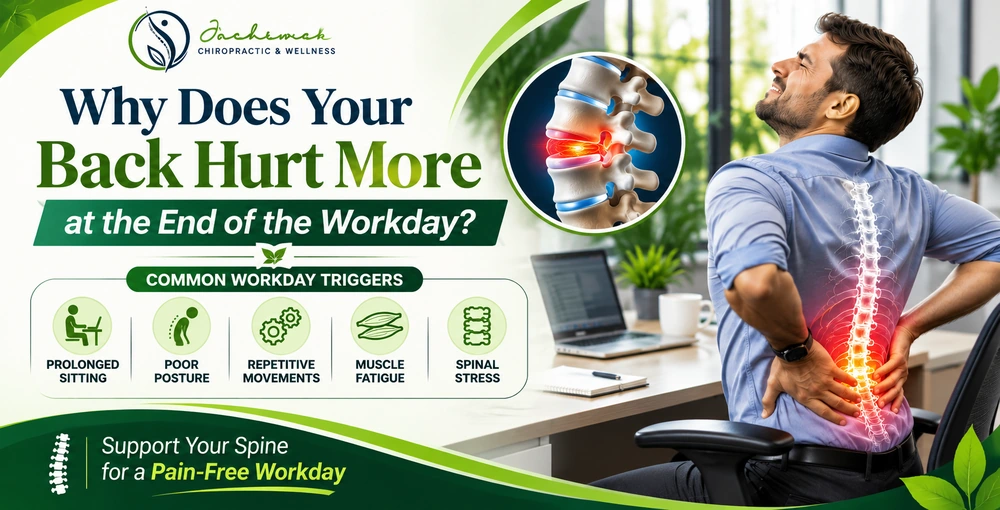
Discover common workday triggers behind evening back pain and learn how to support your spine.
Why Does Your Back Hurt More at the End of the Workday?
Your spine loses fluid under sustained load. Lab studies show spinal discs lose close to 18% of their water content after six hours of steady compression. That changes disc height and shock absorption. Add fatigued muscles and hours of static posture; the pain by quitting time is mechanical.
KEY TAKEAWAYS
- •Spinal discs lose water and height under a full day of load, research confirms.
- •Sitting puts more pressure on lumbar discs than standing does.
- •More than 1 in 4 working adults report low back pain, according to federal NIOSH data.
- •Mostly desk workers feel worse by the end of the day.
- •More willpower can’t fix it. It is usually a mechanical problem with a mechanical answer.
Why Does Back Pain Worsen at the End of the Workday for Desk Workers Specifically?
Sitting is not neutral for your spine. It loads lumbar discs more than standing does, a finding spine researchers have confirmed for decades. Add a forward head posture toward a monitor, and the load shifts further onto the lower back.
An industry poll run through Spine-health.com, reported by the Ergoweb Learning Center, surveyed over eleven hundred desk workers. 17% said their backs felt worse by day's end, 52% called it significantly worse and only 15% felt better.
Our own intake data at Jachimek Chiropractic tells a nearly identical story. Most new patients booking for lower back pain report it building through the afternoon, not flaring in the morning. That timing is a clue, not a coincidence.
18%
Average disc fluid loss after six hours of load
70%
Of desk workers report worse back pain by evening
1 in 4
Working adults report low back pain, per NIOSH
What Actually Happens Inside Your Spine During an 8 Hour Shift?
Your intervertebral discs are mostly water. They absorb shock like a water balloon resists a squeeze. If you put load on the spine for hours, that fluid slowly moves out.
A study published through the National Center for Biotechnology Information compressed human lumbar discs for 6 hours to simulate a working day. Discs lost an average of 18% of their fluid, with the posterior disc wall losing closer to 30%. That is a structural change you are carrying by five o'clock.
Lower fluid content means a stiffer, shorter and less forgiving disc. It transmits more force into surrounding ligaments and joints. This is the mechanical reason back pain worsens through the day, even for otherwise healthy spines doing ordinary desk or counter work.
Is Florida's Workforce More at Risk for This Than Other States?
Tampa Bay is home to desk based healthcare administration, logistics coordination, hospitality management, and long retail shifts. Each of these professions have one thing in common, long stretches in one posture with limited movement breaks.
The U.S. Bureau of Labor Statistics tracks occupational injury patterns nationally. And musculoskeletal strain remains one of the most consistently reported categories in Florida. Heat and humidity add a secondary factor, since workers here sit in air conditioning for longer time than colder climate states allow.
Hillsborough County employs tens of thousands in administrative, medical and logistics roles. These are the exact job categories most linked to static posture and lumbar strain. That is the patient base walking through clinic doors across Tampa, Carrollwood, and Northdale every week.
“Sitting adds large amounts of pressure to the back muscles and spinal discs, even more than standing. People with desk jobs often do not move around much, or they slouch, causing more strain.”
John Triano, DC, PhD, chiropractic researcher and Spine-health.com contributor
What Is the Difference Between Normal End of Day Soreness and a Real Problem?
Normal mechanical fatigue eases with rest. You lie down, discs rehydrate overnight, and you wake closer to baseline. That cycle is expected and not, by itself, a diagnosis. A real problem looks different.
- •Pain spreading below the knee, not just across the lower back
- •Stiffness in the morning that used to disappear by nine now stays past noon
- •Numbness, tingling or weakness in either leg and foot
- •When pain interrupts sleep along with the desk work
Any one of those deserves an actual evaluation. Another over the counter pain reliever is not going to help. In our Chiropractic & Wellness Center, every new patient exam starts with sorting out which category applies before any treatment plan is built. Masking a symptom without finding the cause is simply bad practice.
BEFORE
- Pain builds steadily from noon onward
- Stiffness lingers past the first hour of sleep
- Desk breaks feel pointless, pain returns in minutes
- Over the counter medication barely touches it by Friday
AFTER
- Mechanical cause identified through a real exam
- Spinal alignment and disc pressure addressed directly
- Movement and posture corrections that actually hold
- A plan built around your job, not a generic handout
What Actually Reduces End of Workday Back Pain, Based on the Evidence?
Spinal decompression therapy takes an alternative approach as it aims at creating a negative pressure in the disc to draw the fluids and nutrients back in; thus, counteracting the physiology of the daily routine mentioned above.
Dr. Glen Gunderson, a chiropractic physician with almost 40 years of experience in Tampa, describes the services offered by Jachimek Chiropractic on their website. The clinic's certified KDT spinal decompression program effectively treats herniated discs, sciatica, and degenerative conditions without medication or surgery.
“Most people assume their back pain is just part of the job. It rarely is. When we actually assess the spine, the cause is almost always mechanical, and mechanical problems respond to mechanical correction, not just rest.”
Dr. Glen Gunderson, DC, Jachimek Chiropractic & Wellness Center, Tampa, FL
How Does Spinal Decompression Compare to Other Common Treatments?
Every approach doesn’t address the same mechanism. The table represents what each common option actually does to the spine and it’s not just what it claims to relieve.
| Approach | What It Targets | Limitation |
|---|---|---|
| Over the counter medication | Pain signal, temporarily | Does not change disc mechanics |
| General stretching | Surrounding muscle tension | Does not correct misalignment |
| Massage therapy | Soft tissue, circulation | Short term relief only |
| KDT spinal decompression | Disc pressure and hydration directly | Requires a certified provider |
| Chiropractic adjustment | Joint alignment and nerve pressure | Works best paired with decompression |
These are guidance from NIOSH. It reports more than 1 in 4 working adults experience low back pain and that addressing underlying structural factors prevents the problem from worsening. We, at Jachimek Wellness Center on Ehrlich Road in Tampa, offer a full range of services that pairs decompression with targeted adjustments. That pairing is the difference between temporary relief and resolution.
FAQ
Can poor posture cause back pain with an ergonomic chair?
Yes. A good chair reduces risk but it doesn’t eliminate static loading. Posture habits matter regardless of the equipment.
How long does it take spinal discs to rehydrate overnight?
Most studies show the bulk of disc height recovery happens within the first few hours of lying down. And continuing through a full night's sleep.
Is end of day back pain more common after age 40?
Disc hydration naturally declines with age. So recovery overnight is slower and the end of day effect becomes more noticeable.
Does standing all day prevent this problem?
No. Prolonged standing creates its own load pattern and fatigue in different muscle groups, though the mechanism differs from seated compression.
Should I see a chiropractor or a primary care doctor first?
If pain is mechanical and job-related without radiating symptoms, a chiropractic evaluation is a reasonable first step for an accurate structural assessment.
Your back is supposed to support you.
Jachimek Chiropractic & Wellness Center
Schedule your $47 new patient exam. Call 813.960.2225.