
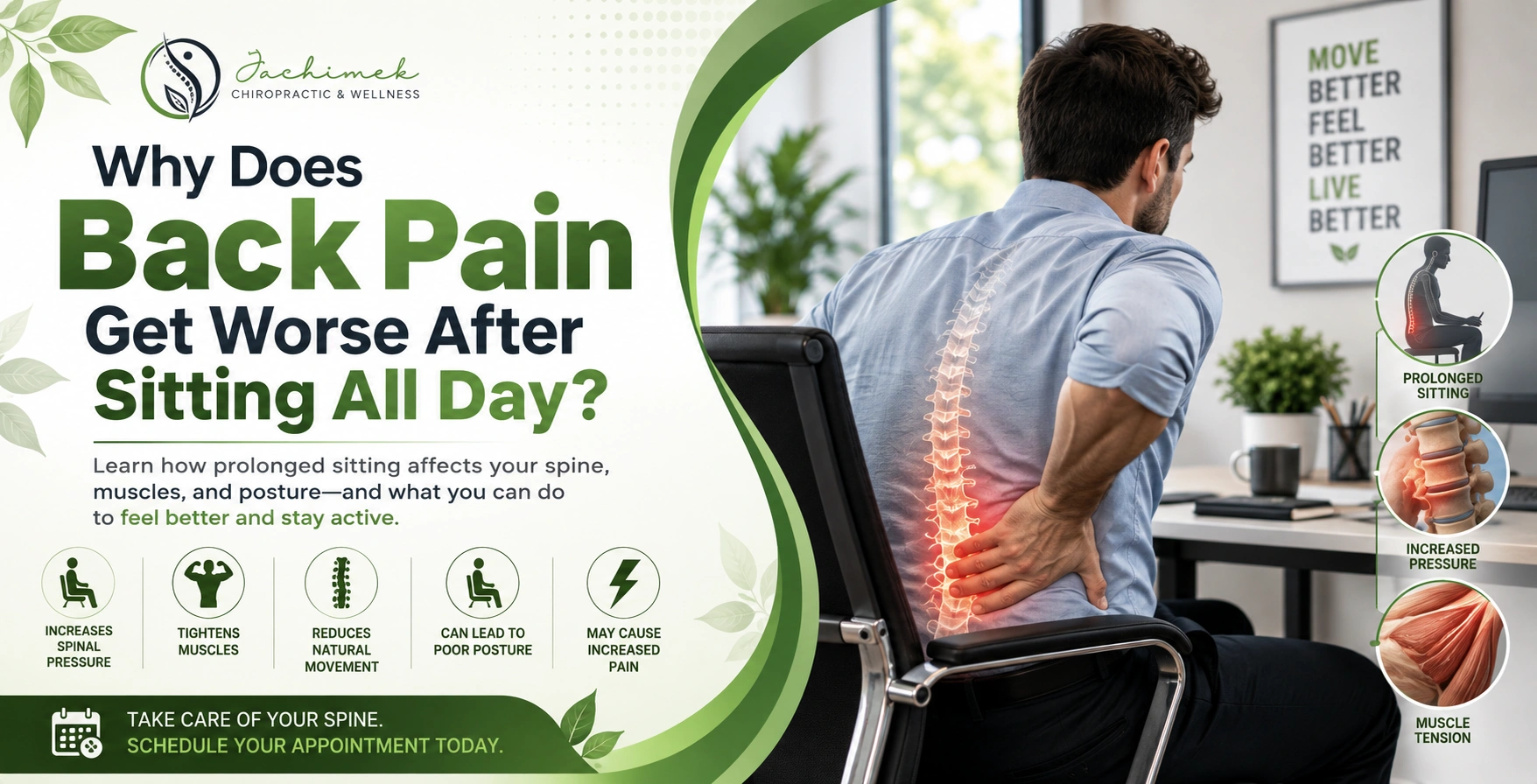
Understand the causes of lower back pain from sitting all day and find practical ways to protect your spine.
JACHIMEK CHIROPRACTIC
Why Does Back Pain Get Worse After Sitting All Day?
Jachimek Chiropractic & Wellness | Tampa, FL
Back pain gets worse after sitting all day because sitting pushes pressure inside your lumbar discs up by roughly 30 to 40% compared to standing. It’s like your spine is quietly losing a fight it never signed up for. And the deep muscles meant to protect your back go slack from disuse. Stack eight hours of that, and your lower back pays for it by afternoon.
KEY TAKEAWAYS
- Your lumbar discs take on 30 to 40% more pressure while you sit than while you stand.
- Roughly 8 in 10 adults deal with low back pain at some point in life, especially desk-bound professionals.
- If pain shows up specifically after sitting, in the afternoon rather than the morning, the culprit is usually disc load and tired core muscles.
- A short break every half hour or so, even just five minutes on your feet, measurably eases both the pressure and the fatigue.
- Jachimek Chiropractic & Wellness treats this with a combination approach, adjustments and decompression when needed.
40%
Higher disc pressure sitting vs. standing
80%
Of adults get low back pain in their lifetime
2/3
Of a typical office workday spent seated
01The Real Cause of Lower Back Pain from Sitting
Sitting is not the enemy by itself. The real problem is how you sit, and for how long. Here is what is really going on inside your back.
- Your spine loses its natural shape. When you stand, your back keeps a gentle curve and your legs and hips carry most of your weight. When you slouch in a chair, that curve flattens out. Now your lower back has to carry weight it is not built to carry alone.
- The old "sitting destroys your discs" claim is not fully true anymore. For years, people were told sitting always squeezes the discs in your spine harder than standing does. Newer research looked at this more closely and found that in a healthy back, sitting and standing put about the same pressure on the discs. So sitting by itself is not the villain everyone thought it was.
- Bad posture is the real problem, not the chair. Slouching forward, rounding your shoulders, and sinking into the seat are what cause trouble. Studies on office workers found real back discomfort within just one hour of slouched sitting, even though upright sitting caused far less strain.
- Weak core muscles let your spine down. Deep inside your belly and lower back, you have small muscles that are supposed to hold your spine steady. If you sit too much without moving, these muscles get weak and stop doing their job properly. Then your ligaments and joints have to take over, and they were never meant to carry that load.
- It builds up slowly, not all at once. Nobody wakes up one day with sudden back pain from sitting. It starts small. A dull ache by afternoon. Stiffness when you finally get up. Waking up and still feeling tight. Over weeks and months, this adds up.
“I hear the same story from patient after patient. Fine in the morning, tight by lunch, and by the time they're walking out the office door their lower back feels locked up. That's hours of disc load and muscle fatigue stacking on top of each other.”
— Dr. Glen Gunderson ("Dr. G"), Jachimek Chiropractic & Wellness, Tampa
02How Long Does It Take for Sitting to Trigger Back Pain?
Most people feel fine for the first 30 to 45 minutes. After that, posture starts to slip and the lower back loses its support. Between two and three hours, a dull ache or stiffness usually shows up. Pass four hours and that ache often locks into the tight, stuck feeling most desk workers know well.
A Typical Desk-Job Pain Timeline
Disc pressure is elevated but stabilizing muscles are not yet fatigued.
Deep core and multifidus muscles begin to fatigue, especially without lumbar support or movement.
Hip flexors shorten, pelvic tilt increases, and lumbar curve continues to flatten under sustained load.
First noticeable dull ache or stiffness typically appears in the lower back or across the hips.
Cumulative disc pressure and muscle fatigue commonly produce the sharper, locked-up feeling most desk workers recognize by afternoon.
03Intradiscal Pressure by Posture - The Range the Research Shows
All sitting don’t your spine the same way. Chair angle, presence or absence of lumbar support, seat recline angles – all of these will affect sitting posture, and so affect the outcome. It’s no surprise, then, that these variables produce a range of possible values – one value for the study as a whole, rather than for a specific chair.
The chart below pulls together what studies have measured across different sitting postures, using standing as the baseline everything else is compared to.
Intradiscal Pressure Load Relative to Standing
Sitting straight up at 90 degrees as we've been taught, actually places more pressure on the spine than a slight recline. A reclining 100 to 130 degrees while keeping the natural curve in the lower back places less stress on the discs.
Stop Guessing at What's Causing Your Back Pain
Get a complete chiropractic consultation, exam, and personalized treatment plan for $47 at Jachimek Chiropractic & Wellness.
Claim the $47 New Patient Special →04Desk Posture Habits That Make Pain Worse vs. What Actually Helps
Some habits that feel protective aren't. Others that sound minor carry real weight. Worth laying out side by side, based on everything covered above.
| Habit | Effect on Lumbar Spine | Verdict |
|---|---|---|
| Sitting bolt upright at 90° | Increases disc pressure versus a moderate recline | Common myth, not protective |
| Reclining seat back to 100°–130° | Reduces disc pressure and ligament strain | Genuinely helpful |
| Crossing legs while seated | Tilts the pelvis and loads one side of the lumbar spine unevenly | Worsens asymmetric pain |
| Standing desk used all day, no breaks | Trades disc pressure for prolonged static muscle fatigue | Not a full fix on its own |
| 5–10 min movement break every 30–45 min | Restores disc hydration and resets fatigued stabilizers | Strongly protective |
| Lumbar support cushion | Maintains natural spinal curve, lowers disc load | Genuinely helpful |
05How Jachimek Chiropractic Approaches Sitting-Related Back Pain
Fixing this well means going after both problems at once, the compressed disc and the muscle that's given up on the job, instead of just chasing whatever hurts today. Here's roughly what that looks like at Jachimek Chiropractic & Wellness.
Assessment & History
A hands-on exam plus a detailed look at your work setup, hours seated, and pain pattern through the day.
Spinal Adjustment
Chiropractic adjustments to restore joint motion and take pressure off compressed segments and irritated nerves.
Spinal Decompression (as indicated)
Non-surgical decompression therapy to gently reduce pressure on affected discs and support rehydration.
Targeted Rehab Exercises
Core and hip mobility work aimed directly at the multifidus and hip flexor patterns that sitting creates.
Posture & Break Plan
A specific, realistic movement-break schedule built around your actual job, not a generic handout.
06Is There Any Way to Avoid Back Pain from Sitting at Work Without Changing Jobs?
According to the National Institute of Neurological Disorders and Stroke, 80 percent of adults suffer back pain during their lifetimes, and sitting habits are considered a proven risk factor when it is combined with lack of physical activity during the week.
A randomized study tracked in the CDC's NIOSH occupational health archive cut desk workers' sitting time by about 1.5 hours a day. They found real improvement in pain, energy, and sleep, without hurting productivity or focus at all. That last part is the one people worry about most, and it turns out not to be a tradeoff. This is a short list, and it holds up whether you're at a desk in an office or a kitchen table at home.
“None of this works if it doesn't fit into someone's real day. We're not handing out the same printout to every patient. We look at their actual chair, their actual hours, and build something they'll realistically stick with.”
— Dr. Juliet Marvenko ("Dr. J"), Jachimek Chiropractic & Wellness, Tampa
The American Academy of Orthopaedic Surgeons and other clinical groups consistently point out that most low back pain responds to conservative care first, targeted exercise, manual therapy, changing how you move through your day, well before anything more invasive gets considered. That's the same approach behind chiropractic and decompression care at Jachimek in Tampa. Fix what's actually driving it, don't just manage it forever.
Explore our full range of treatments on our services page, or read more posture and spine health articles on The Wellness Journal.
Frequently Asked Questions
Is it better to sit or stand all day for back pain?
Neither, honestly. Standing all day just trades disc pressure for a different problem, static fatigue in your legs and lower back. Switch between sitting and standing throughout your day.
Can a bad mattress make sitting-related back pain worse?
It can. If your mattress doesn't support your lumbar curve overnight, your discs don't get the recovery and rehydration they need. Then the pain from your desk day just carries straight into the next one.
How many minutes should I stand for every hour I sit?
Most occupational research points to something like 5 to 10 minutes on your feet for every 30 to 45 minutes seated.
Want to know who you will be working with? Meet the Jachimek Chiropractic team before your first visit.
Disclaimer: This information is not medical advice directly. For your unique situation, contact the care team at Jachimek Chiropractic & Wellness, 5111 Ehrlich Road Ste 128, Tampa, FL 33624.
Your Back Doesn't Have to Wait Until It's Unbearable
Jachimek Chiropractic & Wellness helps Tampa Bay professionals fix sitting-related back pain at the source. New patients start with a full exam and personalized plan for $47.
Book Your Visit at Jachimek Chiropractic & Wellness →